
On What to Work on?
I’ve recently read two essays:
So obviously I feel couched right now - let’s use this moment before I realize that it doesn’t have too much sense!
it’s not impressive to make the same thing over and over, however well; you’re just copying yourself.
— Paul Graham
I am willing to take as much time as needed between projects to find my next thing. But I always want it to be a project that, if successful, will make the rest of my career look like a footnote.
— Sam Altman
It’s easy to be busy, shuffle JSONs from left to right and feel productive. When you are in this state it feels bad to stop. However, from time to time one must stop and think if these JSONs matter at all.
— Piotr Proszowski
There are two opposite forces:
- The more things you do - the better
- The more meaningful things you do - the better
When you focus too much on the first one - you may end up in the situation where results of you’re work are meaningless and you might as well do nothing (or even worse, they are net negative and it would be better if you were doing nothing). However, there is lot of benefits of doing meaningless projects:
- you learn a lot by doing. So even if outcomes aren’t that obvious, you accumulate skills that may be crucial once you start working on this great project that will change everything.
- you may discover meaningful projects to work on. Let’s say you work on meaningless project X. At some point you hit the problem that is generic and painful - solving it would be vaulable for other meaningful projects which makes it meaningful.
- expectations are much lower for such project. It’s eaiser to start and push it - especially if the project is fun for you. There is no pressure and it’s just fine to abandon it.
- you gain energy. Recently I saw a cool project: nailing jellies to a wall. It’s ridicolous. It reminded me that there is another upside of doing meaningless project - it can give you some fun and energy, which is necessary to push things forward.
When you focus too much on the latter - you may end up in analysis paralysis. You start constantly asking questions: Is it the right thing to work on? and start looking for more meaningful quests. The trap here is that thinking take the whole space and you don’t do anything at all. Even if you might have great intuition what should be done everything seems too far away to even start.
There is a famous xkcd Is It Worth the Time? that always triggers me when raised in discussion: https://xkcd.com/1205/.
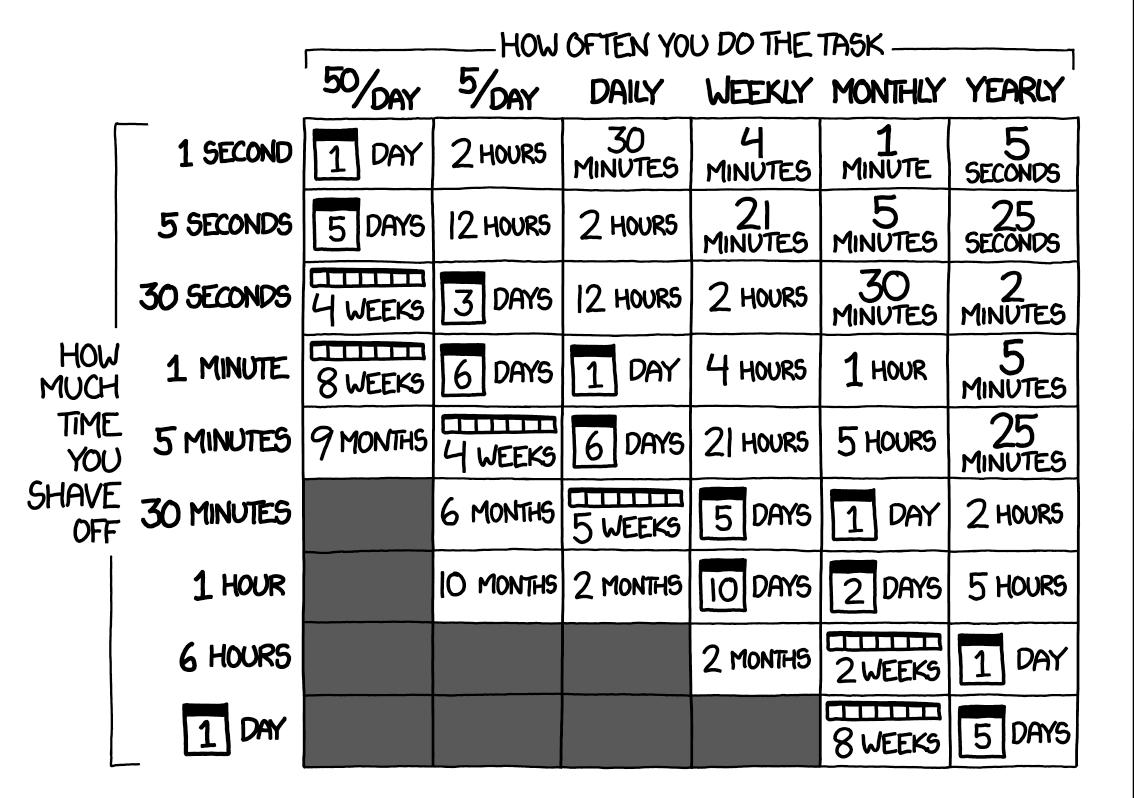
It says, that if automation of something takes longer than it will save time, then you shouldn’t do that, however:
- very often we underestimate how much time we spend on manual activities (and possibility that frequency may change in the future)
- it takes only time into equation and doesn’t take cognitive load
- doesn’t take into consideration, that when doing automations very often (even those that seem meaningless) the person becomes capable of doing all kind of automations much faster (even those that are incredibly meaningful).
So even if you assess with above diagram that 30 minutes is worth to spend time on automating something and you estimate that it will take you 1 day - it still may be worth doing it. The biggest value is in what you learn on the way.
Currently I think that a great way to navigate this problem is this:
- maintain a list of things you could be working on
- regularly review what you’re working on and what you could work on
- prioritize hard - make sure that in the queue of things to do there are less important items then ones you’re currently working on - don’t hesitate to change what you’re currently working on
- make sure you keep doing things - even if at the moment it feels like things you work on could be more meaningful
So even if you don’t work currently on anything that looks like something that will make the rest of your career look like a footnote - don’t worry, you need a solid footnote as well which may consist of much less meaningful projects then you think :)
Have fun!